EIC Accelerator : How It Funds Scale-Up Innovations from TRL6 to TRL9

Scaling an innovation from the laboratory to market readiness is one of the toughest journeys a startup can undertake. This critical transition—from Technology Readiness Level (TRL) 6 to TRL 9—often demands substantial funding and strategic support that typical private investors may shy away from due to high risk. The European Innovation Council (EIC) Accelerator is specifically designed to bridge this funding gap, providing unique support for high-impact, deep-tech innovations with significant market potential.

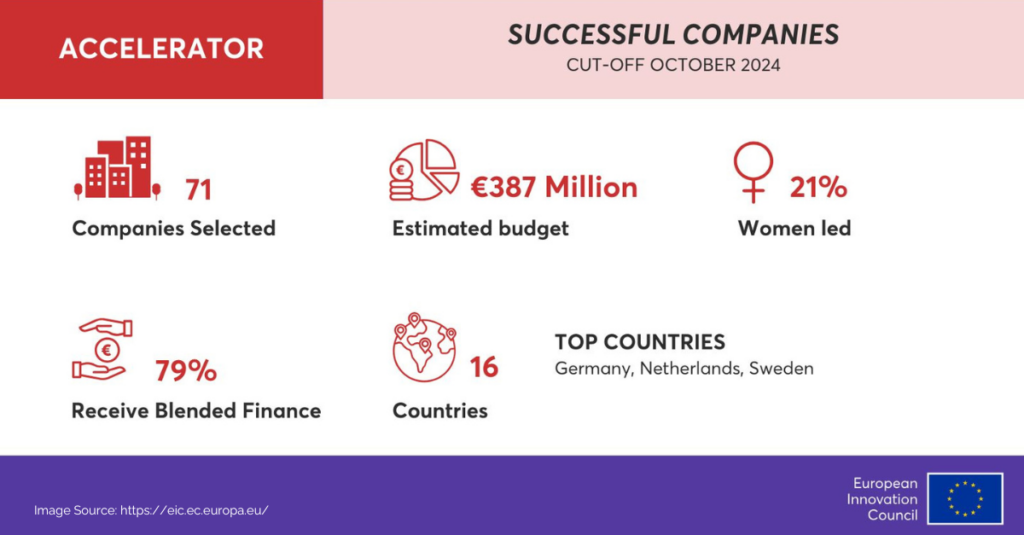
In October 2024 alone, the EIC Accelerator allocated an impressive €387 million to 71 innovative startups, highlighting its pivotal role in Europe’s innovation ecosystem.

What is the EIC Accelerator?

The EIC Accelerator, part of Horizon Europe, supports SMEs, startups, and even individual innovators committed to scaling groundbreaking technologies. It targets deep-tech innovations requiring significant capital and time before generating returns—so-called patient capital. The EIC Accelerator stands out due to its versatile funding options, including grant-only, blended finance (grant plus equity), and equity-only models. This flexibility enables it to cater specifically to the needs of innovators at different stages of market readiness.

Funding Models and Key Metrics

Types of Funding

Grant Only: Provides up to €2.5 million for innovation activities between TRL6 and TRL8.

Blended Finance: Combines grant funding with equity investment, typically ranging from €0.5 million to €10 million, facilitating both development and market deployment.

Equity Only: Offered to startups ready for rapid scaling and market expansion, especially when traditional financing isn’t feasible.

October 2024 Results

In the recent October 2024 round, €387 million was allocated, with each company receiving an average of €5.45 million:

Blended Finance: 56 companies (78.9%)

Equity Only: 5 companies (7%)

Grant Only: 10 companies (14.1%)

The clear dominance of blended finance illustrates the EIC’s strategic preference for sustainable, scalable innovations that attract further private investments.

The EIC Accelerator 2025 Application Process

Securing EIC Accelerator 2025 funding involves a highly competitive, multi-stage evaluation:

Short Proposal

Applicants first submit a concise application, including a pitch deck and a short video.

Evaluated remotely by four EIC experts, focusing on innovation novelty, impact, and team capability.

Full Proposal

Successful applicants receive coaching support to refine a comprehensive business plan.

Submitted proposals undergo detailed remote evaluation by three new experts, assessing excellence, impact, and risk management.

Face-to-Face Interview

Finalists present their innovation to an EIC jury, who determine funding recommendations based on both the pitch and the full proposal evaluation results.

Navigating Success: Tips and Best Practices

Crafting a Compelling Proposal

Your proposal must clearly demonstrate not only the technological breakthrough but also a robust market entry strategy. Highlight scalability, competitive advantages, and thorough risk mitigation measures.

Leveraging Business Acceleration Services

Take advantage of EIC’s business coaching to perfect your business model and presentation strategy. The support can be instrumental in addressing potential weak points identified during the short proposal stage.

Common Pitfalls to Avoid

Unclear market opportunity: Clearly define your target market and growth potential.

Weak risk management: Detail your strategies for overcoming technological, market, regulatory, and financial risks.

Insufficient evidence of TRL progression: Provide clear, measurable milestones demonstrating your readiness to move from laboratory validation (TRL6) to market launch (TRL9).

Geographical Insights and Strategic Implications
The EIC Accelerator’s recent funding highlights its broad geographic support across Europe, although major hubs continue to dominate:

Germany (21.1%) and the Netherlands (15.5%) lead in funded projects, underscoring strong local innovation ecosystems.

Smaller innovation communities like Bulgaria, Poland, Portugal, and Luxembourg also secured funding, demonstrating the Accelerator’s inclusive approach to fostering innovation regardless of geographic size or history.

This geographic diversity emphasizes the EIC’s role in enhancing innovation capabilities and strategic autonomy across Europe, creating opportunities even in emerging startup ecosystems.

Conclusion

The journey from TRL6 to TRL9 is undoubtedly challenging, but the EIC Accelerator 2025 provides essential resources and guidance to navigate it successfully. The latest funding round reinforces the program’s strategic role in driving European innovations towards global market success.

For startup founders and consultants advising innovation-driven enterprises, the EIC Accelerator offers not only substantial funding but also credibility and validation in the market. Now is the time to prepare your proposal, leverage available support, and position your startup for the next funding round.

Ready to apply but short on time or support? Typewiser can help. Our AI-powered grant writing software is built specifically for the EIC Accelerator—designed to save you weeks of effort, reduce costs, and boost your chances of success. Whether you’re a founder or a consultant managing multiple applications, Typewiser gives you the edge you need.

👉 Start your proposal with Typewiser today

The October 2024 EIC Accelerator: A Record-Breaking Round of Innovation

The European Innovation Council (EIC) Accelerator program has once again raised the bar, making its October 2024 funding round the most competitive in history. As of February 2025, 71 game-changing companies have secured a total of €387 million in funding through the EIC Accelerator. The results reflect the program’s growing impact on breakthrough innovation in Europe.

An Unprecedented Level of Competition

With 1,211 proposals submitted, only 6% made the final cut. Out of those, 431 companies advanced to jury interviews before the final selection. 

How Was the Funding Distributed?

Here’s how the €387 million was allocated:

  • Blended finance (grant + equity): 56 companies (79%)
  • Grant-only funding: 10 companies (14%)
  • Equity-only funding: 5 companies (7%)

Blended finance is increasingly becoming the preferred model, ensuring companies receive both immediate capital and long-term investment. 

Did you know some startups get a fast track to EIC Accelerator funding? The ‘Plug In’ scheme allows certified national and regional programs to submit top projects directly to the final application stage—helping innovators secure funding faster.

For the 330 companies that impressed the EIC jury but missed out due to limited funds, the Seal of Excellence opens doors to alternative funding like the Recovery and Resilience Funds and European Regional Development Funds.

Where Are the Winners From?

Innovation is happening all over Europe, but some countries stood out more than others.

The selected companies represent 16 countries, with Germany leading the way (21%), followed by the Netherlands (16%) and Sweden (10%). 21% of the funded startups are led by women (CEO, CSO, or CTO), showcasing a positive shift toward diversity. These results highlight the evolving landscape of innovation supported by the EIC Accelerator.

Which Sectors Are Shaping the Future?

The EIC is betting big on cutting-edge technologies that will redefine industries. Here’s where the money is going:

  • Deep Tech: Quantum computing and advanced semiconductors
  • AI & Data: AI security and synthetic data generation
  • Healthcare & Biotech: Medical devices and gene therapy
  • Energy & Sustainability: Green hydrogen and carbon capture technologies

Meet the Game-Changers: Startups to Watch

Among the winners, a few startups are making waves with their groundbreaking ideas:

  • Brineworks: Extracting CO₂ and hydrogen from oceans in a sustainable way.
  • MOA Biotech: Turning agrifood byproducts into high-value proteins.
  • SICSAI: Developing an Artificial General Intelligence (AGI) model for robotics.
  • CorPower Ocean: Secured up to €17.5 million to advance wave energy technology.
  • BioThrust: Creating bioreactors that revolutionize large-scale cell production.

Which of these innovations excites you the most, and how could they change the world?

Looking Ahead: What’s Next for Innovation?

With such an impressive lineup of startups, the future of European innovation looks bright. As these companies develop their technologies, they could transform industries like clean energy, artificial intelligence, and biotechnology. Backed by the EIC Accelerator, these breakthroughs have the potential to drive significant impact across sectors.

Bridging the Gap: How Can Startups Improve Their Chances of Success?

As funding competition intensifies, how can startups improve their chances of success? One crucial factor is the ability to communicate their vision effectively through compelling grant applications, pitches, and investor proposals. This is where Typewiser comes in—helping innovators craft impactful submissions that resonate with evaluators and investors, especially in programs like the EIC Accelerator.

By offering AI-powered writing assistance tailored for startups and innovators, Typewiser helps craft persuasive, high-impact funding applications that maximize success rates. Whether refining a proposal or structuring a pitch, having the right words can make all the difference. If you’re looking to boost your startup’s chances in the next EIC round, Typewiser could be your secret weapon.

Stay tuned as we follow the journeys of these startups and witness the next big breakthroughs!

The content of this document was created with support from Typewiser.

Top EIC Accelerator Application Tips for 2025

The EIC Accelerator is one of the most competitive funding programs for deep-tech innovations. If your short application has been approved, you’re already on the right track, but the full proposal is where the real challenge begins. 

Short application evaluations are conducted after the first Tuesday of every month and typically take 4 to 6 weeks. With the March 12, 2025, deadline fast approaching, it’s time to focus on creating a proposal that truly highlights your project’s strengths.

In this blog, we’ll share practical tips to help you meet the EIC’s criteria and take your application to the next level. Let’s dive in!

Strategic Considerations for Your Full Proposal Preparation

The EIC Accelerator is more than just funding—it’s an opportunity to take your project to the next level. To stand out, your full proposal needs a clear strategy and thorough preparation. Here’s how to make sure you’re putting your best foot forward:

Sharpen Your Project Focus

Your proposal should clearly explain how your technology works, who it serves, and the value it delivers. The EIC looks for solutions with tangible results, so focus on these key areas:

  • Target Use Case: Describe the specific problem your technology addresses and its real-world application. Highlight how it solves critical challenges and creates value where it’s needed most.
  • Market Fit and Potential: Define your target market and its needs. Emphasize the size of the market, growth opportunities, and gaps your solution fills. Show you understand your customers and how your solution meets their expectations.
  • Alignment with EU Priorities: Link your project to EU goals like sustainability, digital transformation, or technological independence. Explain how your work supports these priorities while staying focused on your specific use case.

Outline a Robust Project Strategy

A successful proposal goes beyond describing what you’re building—it outlines the steps you’ll take to make your innovation market-ready. Include these elements in your strategy:

  • Project Goals and Milestones: Clearly define your objectives and the key steps to achieving them. Highlight the potential impact on your industry or market.
  • Work Plan: Provide a detailed roadmap that includes milestones, deliverables, and timelines. This shows that your project is practical and achievable.
  • Team Competence: Showcase your team’s expertise and experience. Explain why your team is uniquely equipped to deliver the project and how your track record backs up your ambitions.

Yellow creative Bulb, question marks around, white background, Typewiser, AI text generatorTarget Market and Commercial Strategy

Zeroing in on a single, well-defined market application is key to demonstrating the potential of your innovation. This focus establishes a clear path to success while paving the way for growth into related markets. Here’s how to approach it:

  • Market Analysis: Share data-driven insights about your target market, including its size, growth potential, and unmet needs. Highlight why this market is the best starting point for your solution and how it aligns with your overall vision.
  • Go-to-Market Strategy: Lay out a detailed commercialization plan tailored to your chosen market. Discuss strategic partnerships, customer acquisition tactics, and distribution channels that will drive your market entry. A well-thought-out plan shows you’re prepared to deliver.
  • Scalability: Show how your success in the primary market can lead to growth in related markets. Identify adjacent opportunities that align with your innovation and have strong potential for expansion.

Funding Scenario

The EIC Accelerator offers three funding options: grant-only, blended finance, and equity-only. Choosing the right option and presenting a compelling financial case can make your proposal stand out:

  • Blended Finance: If you’re requesting blended finance, explain how the EIC’s funding will reduce risks and attract private investors. Showcase how this approach strengthens your project’s investment appeal.
  • Financial Plan: Break down how you plan to allocate the funds and ensure the project becomes self-sustaining. A transparent and logical financial plan adds credibility to your proposal.
  • Projections: Provide realistic projections for revenue growth, profitability, and scalability. Concrete, evidence-backed forecasts highlight the financial potential of your project.

Annex Documents: Building a Coherent and Credible Story

Annex documents are more than just add-ons—they are the backbone of your proposal, providing the evidence evaluators need to believe in your project. These documents reinforce the narrative in your main application, making clarity, alignment, and attention to detail essential. Any inconsistencies or gaps could undermine your case, so ensure every annex tells the same compelling story as your main proposal.

  • Pitch Deck: This is your story in a nutshell—a concise, visually engaging summary of your project. Beyond being a supporting document, it’s also your key tool during the interview stage. A clear, compelling pitch deck that highlights your innovation, its impact, and your vision can leave evaluators confident in your project’s potential.
  • Financial Annex: Numbers speak volumes. Use your financial annex to show ambitious yet realistic growth projections, backed by evidence. Clearly justify your funding needs, explain how the EIC’s support will de-risk your project, and outline how the investment will be allocated. A well-integrated financial plan shows evaluators that you’re prepared to scale and succeed.
  • FTO and DMP: The Freedom to Operate (FTO) analysis assures evaluators that your innovation is free from intellectual property conflicts. A solid Data Management Plan (DMP), even if brief, demonstrates your understanding of data handling best practices and regulatory compliance. These documents show you’ve thought ahead and are ready to deliver responsibly.
  • Letters of Intent: Annexed letters from potential partners or customers are like gold stars for your proposal. They validate market interest and provide tangible evidence of external support, boosting the credibility of your project.

Documents on white background, placed neatly, hints of orange and white, Typewiser, AI text generatorLeveraging Generative AI to Accelerate Proposal Writing

Preparing a full proposal can be daunting, but Generative AI can be your secret weapon. With Typewiser, you can fast-track the process and focus on refining your content, ensuring you meet the March 2025 deadline without the stress.

Typewiser’s EIC Accelerator Full Application Template is crafted to align perfectly with what evaluators expect. 

From generating first drafts to fine-tuning sections based on the EIC Work Plan 2025, Typewiser’s AI-driven tools help ensure your proposal is complete, compliant, and compelling. With our Chat feature, you can get real-time advice and revisions tailored to your specific project, maximizing your chances of success.

Don’t just write your proposal—craft a story that resonates, backed by solid evidence and strategic insight. 

Let Typewiser assist you in crafting an EIC Accelerator application that captures attention and boosts your chances of success.

Sign up for free!

EIC Accelerator Challenges 2025: Driving Innovation in EU Funding Programs

The EIC Accelerator is all about driving innovation that makes a real impact. Like other EU funding programs, EICA is here to back bold projects that create new markets or completely transform old ones.

In 2025, it’s all about “Challenge Calls” focusing on Europe’s top priorities.

screws on a page, aesthetic white image, EU funding programs, EIC challenges 2025

What Are the EIC Accelerator Challenges?

The EIC Accelerator Challenges are all about pushing boundaries in tech and innovation. They tie into the big goals of EU funding programs like sustainability, technological independence, and staying competitive.

Each Challenge comes with a dedicated budget to back projects that drive real societal and industrial change. If your idea doesn’t fit a specific Challenge, the Open Call gives you the freedom to show its impact across EU initiatives.

Whether through a Challenge or the Open Call, the EIC Accelerator is here to help innovation thrive.

The Challenge Calls for 2025

The EIC Accelerator is setting the stage for 2025 with five impactful challenges, each designed to target critical areas of innovation. Here’s what’s on the agenda:

1. Acceleration of Advanced Materials Development and Upscaling Along the Value Chain

Indicative Budget: €50 million

The first challenge focuses on advanced materials shaping the future of energy, mobility, electronics, and construction. From additive manufacturing to AI-driven material design, it’s about turning scientific breakthroughs into scalable industrial solutions while embracing sustainable practices. 

Goals & Results

The aim is to create a robust framework for developing cutting-edge materials within Europe, fostering collaboration across industries and reducing dependency on non-EU resources. The result? Faster industrial adoption of innovative materials, enabling Europe to lead in global sustainability and technological advancement. 

2. Biotechnology-Driven Low-Emission Food and Feed Production Systems

 food biotechnology, man holding bell pepper, EIC accelerator challenges 2025, EU funding programs
Indicative Budget: €50 million

This challenge is all about reshaping agriculture through biotechnology, with an emphasis on reducing greenhouse gas emissions and boosting sustainability. Technologies like microbial fertilizers, biopesticides, bio-stimulants, precision farming tools, and methane-reducing livestock solutions are at the forefront.

Goals & Results

The goal is to create efficient, low-emission food production systems that promote sustainability across the EU. The result? Reduced emissions, enhanced biodiversity, and a more resilient European agri-food sector—advancing strategic autonomy and aligning with the EU’s climate and sustainability goals.

3. GenAI4EU: Creating European Champions in Generative AI

Indicative Budget: €50 million

Generative AI (GenAI) is reshaping industries, and the EIC Accelerator is here to ensure Europe leads the charge—ethically and responsibly. Supported by EU funding programs, this challenge backs projects that harness GenAI in transformative sectors like healthcare, energy, security, education, and manufacturing.

What does this mean? It could involve building new GenAI models, tailoring existing ones for specific industries, or weaving them seamlessly into real-world operations. At its core, the focus is on creating AI systems that are ethical, transparent, and trustworthy.

Goals & Results

The aim is clear: establish Europe as a frontrunner in human-centric GenAI. This challenge is about empowering smarter decision-making, boosting productivity, and reducing dependence on non-EU technologies—all while upholding EU values and ethical standards.

4. Pushing Boundaries in Space Tech

space technology, white image,  EIC accelerator challenges 2025, EU funding programs

Budget: €50 million

Space innovation is taking a bold leap forward with this challenge. Think satellite repairs in orbit, cutting-edge tools to clean up debris, and advanced systems to keep space infrastructure secure and resilient. Projects will focus on autonomous solutions, secure connectivity, and innovative ways to extend satellite lifespans.

Goals & Results

Europe is gearing up to lead the charge in space innovation—driving smarter, cost-effective technologies, reducing space debris, and ensuring a stronger, more sustainable future for its space operations

5. Breakthrough Innovations for Future Mobility

Budget: €50 million

The future of transport is getting a major boost with this challenge. Backed by EU funding programs, it’s all about advancing low-emission solutions for vehicles, ships, and aircraft. From AI tools that enhance transport efficiency to smart charging systems and sustainable fuels for aviation and maritime sectors, this challenge focuses on transformative technologies that make mobility greener and smarter.

Goals & Results

These innovations are set to drive big changes—cutting emissions, boosting efficiency, and supporting Europe’s climate neutrality goals. It’s about creating a safer, more connected, and sustainable transport system for the future. 

Take the first step towards funding your innovation 

innovation, bulb image The 2025 EIC Accelerator Challenges bring a powerful opportunity to the table. With well-defined goals and substantial funding, they open doors for startups and SMEs to create solutions that drive impact. If your idea aligns, this could be your breakthrough moment in European innovation.

Don’t let grant writing slow you down. With Typewiser, our AI grant writing software, the EIC Accelerator application process becomes seamless. Expert-level proposals in minutes mean more time for you to innovate and scale.

Want to learn more about the EIC Accelerator?

Join us on the 17th at 15:00 CET for an exclusive webinar about the EIC Accelerator and how Typewiser can streamline your grant writing process. Don’t miss out—register here.

EIC Info Day Recap: What’s New for the EIC Accelerator?

Last week, the European Innovation Council held the EIC Info Day, packed with key updates from the 2025 Work Programme. Alongside changes to the EIC Pathfinder, EIC Transition, and EIC Accelerator schemes, they also announced a new STEP scale-up call targeting strategic technologies.

What’s New for the EIC Accelerator in 2025?

Interest in the EIC Accelerator is at an all-time high—and it’s easy to see why. With a unique blend of grant and equity support, the program helps start-ups and SMEs with market-disrupting technologies scale up and access new markets.  As a result, competition has become fierce.If you couldn’t tune into the EIC Info Day, here’s a quick catch-up:

  • Full Application 2025 Cut-Off Dates: The cut-offs remain unchanged from the confirmed dates in the EIC 2025 Work Programme. There will be only two EIC Accelerator Full App cut-offs in 2025: March 13th and October 1st. 
  • Short Application Evaluation Windows: For applicants targeting the next Full Application cut-off, Short applications will now be evaluated in batches on the first Tuesday of every month. To receive feedback and prepare for the March cut-off, you’ll need to submit by either December 3, 2024, or January 7, 2025.
  • New Maximum EIC Equity Request & 2025 Budget: Blended finance applicants can now request up to €10 million, down from the €15 million limit set during the EIC Accelerator pilot. The 2025 budget has also been slightly reduced, with €634 million allocated compared to €675 million in 2024. These adjustments are linked to the launch of the STEP call, which offers investment support ranging from €10 million to €30 million, with a total budget of €300 million for 2025.
  • No More Travel Reimbursement for Interviewed Companies:
    Companies invited to the last step of the selection process — pitch and interview sessions in Brussels will no longer receive travel or accommodation reimbursements.

Updates to Eligibility & Evaluation Criteria

One of the key changes announced by the EIC is raising the minimum Technology Readiness Level (TRL) requirement to 6. This means any work at TRL 5 must be completed first, as it’s no longer eligible for grant funding under the EIC Accelerator’s project work plan.

Another big update is about Equity Only support. In the past, only companies that had previously won Horizon Europe grants could apply. That requirement has been dropped, so now companies can apply for Equity Only funding without needing to prove they’ve received a grant before

Evaluation Updates

During the EIC Info Day, there was a strong focus on backing deep-tech innovations and truly groundbreaking technologies—not just incremental changes or purely research-focused projects. Here are a few more key updates:

  • Company Excellence Sub-Criterion Removed: This evaluation criterion for EIC Accelerator applicants has been taken out and is now used for the STEP call instead.
  • Revised Risk Level of Investment Criterion: This has been reworded to assess whether a company can attract further investment with EIC support over the next two years.
  • New Question for STEP Call Objectives: A new question has been added to specifically evaluate how projects impact STEP call objectives.

Lastly, it’s been clarified that when Full Applications for Open and Challenge calls are reviewed in consensus meetings (where two evaluators approve and one rejects), the final decision to proceed must be unanimous for an interview invitation to be issued.

Seal of Excellence and Sovereignty Seals

The Seal of Excellence (SoE) will now be awarded only to companies that reached the Interview stage but didn’t receive funding due to EIC budget constraints. This recognition is meant to help these companies access other funding opportunities more easily. In addition, SoE awardees will have access to the EIC’s Business Acceleration Services. 

A new addition to the 2025 Work Programme mentioned during the EIC Info Day, is the Sovereignty Seal, also known as the STEP seal. This seal will be given to both STEP call proposals and Accelerator Challenge proposals that align with STEP objectives. It will be awarded to projects that received funding and even those that missed out due to budget limitations.

2025 Open & Challenge Calls

The Open call will be available annually, designed to support projects from any scientific field, provided they demonstrate novel, deep-tech, breakthrough solutions. The total budget allocated for the Open call is €384 million.

A total budget of €250 million has been allocated for the 2025 Challenge calls, which include:

  • Acceleration of Advanced Materials Development and Upscaling along the Value Chain
  • Biotechnology-Driven Low Emission Food and Feed Production Systems
  • GenAI4EU: Creating European Champions in Generative AI
  • Innovative In-Space Servicing, Operations, Robotics, and Technologies for Resilient EU Space Infrastructure
  • Breakthrough Innovations for Future Mobility

Whether you’re aiming for the Open call or have a project that fits within one of the strategic Challenge calls, preparing a strong application is critical to maximising your chances of success.

Ready to Secure Funding for Your Innovation?

The clock is ticking for the March 2025 EIC Accelerator deadline—an impactful application is key to unlocking grant support for your innovation.

This is where Typewiser comes in. Our AI grant writing software turns the complex task of crafting an EIC Accelerator proposal into a seamless experience. Create expert-level applications in just minutes, giving you more time to focus on what truly matters—innovating and scaling.

Don’t wait—let Typewiser help you secure the funding you need.

Sign up now to get 200 free Typewiser credits! 

Curious about how our AI-powered grant writing software works? Book a free demo!